
 PREVIOUS
Model for Panic Anxiety–Associated Cognitive Impairment
Newsletter # 127

In vivo studies
Cognitive dysfunction is an overlooked but devastating component of panic disorder. Beyond the paralyzing fear of recurrent panic attacks, patients struggle with working memory lapses, poor attentional control, and impaired decision-making—deficits that undermine daily functioning and resist standard treatment. Addressing these cognitive symptoms is now recognized as a critical frontier in improving patient outcomes.
Cholecystokinin tetrapeptide (CCK-4) offers a unique opportunity to bridge this gap. In humans, CCK-4 reliably provokes panic attacks; in rodents, it recruits the same limbic and prefrontal circuits that govern both fear and cognition. This dual action makes CCK-4 an ideal experimental tool to model panic anxiety–associated cognitive dysfunction—something classical amnesia paradigms such as scopolamine or MK-801 cannot capture.
-
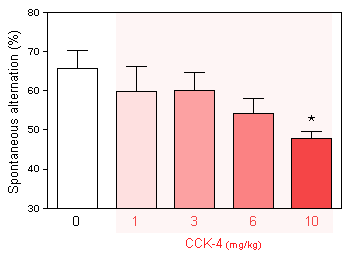 * indicates p ≤ 0.05, as compared to white column
-
At Neurofit, we demonstrated that CCK-4 administration in mice induces a robust, dose-dependent reduction in spontaneous alternation in the T-maze, a hallmark of cognitive deficit. This effect was consistent and reproducible, validating CCK-4 as a reliable pharmacological model of anxiety-linked cognitive impairment.
-
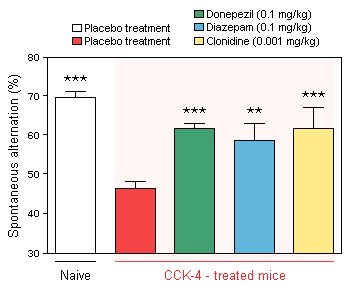 **, *** indicates p ≤ 0.01 and p ≤ 0.005 as compared to white Naive column
-
Crucially, pharmacological profiling revealed a selective signature. Diazepam and clonidine—both proven panicolytics—reversed the CCK-4–induced deficit, highlighting the involvement of stress-related mechanisms. Donepezil, a cognitive enhancer, also restored performance, underscoring the potential of cholinergic augmentation in anxiety-related cognitive dysfunction.
-
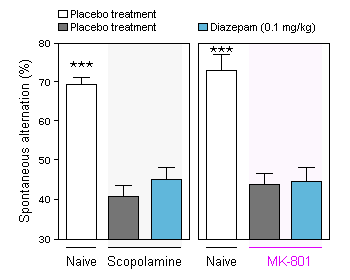 *** indicates p ≤ 0.005, as compared to white Naive column
-
By contrast, diazepam failed to rescue scopolamine-induced deficits (amnesia model) or MK-801–induced deficits (psychosis model), confirming that the CCK-4 paradigm reflects a distinct, anxiety-driven cognitive pathology rather than memory loss or psychosis-related impairment. Together, these findings establish CCK-4–induced impairment as a clinically relevant preclinical paradigm for discovering therapies that can simultaneously reduce panic anxiety and restore cognitive control