 PREVIOUS
Newsletter # 130
In vivo studies
One promising avenue involves interference with the 5-HT₂A receptor pathway, which plays a key role in modulating cortical excitability and has been implicated in the pathophysiology of psychosis.
M100907 (Volinanserin, VOL) is a highly selective 5-HT₂A antagonist that has shown to be well tolerated in humans, exhibiting clear anti-hallucinogenic properties and limited, but potentially valuable, antipsychotic efficacy without the liabilities associated with dopamine D₂ receptor blockade.
PCP (phencyclidine) -induced hyperlocomotion in mice serves as a robust preclinical model for the positive symptoms of schizophrenia, such as psychomotor agitation and hallucination-like behaviors. This effect arises from NMDA receptor blockade on cortical and subcortical circuits, leading to increased dopaminergic activity and cortical disinhibition—mechanisms closely aligned with the pathophysiology of psychosis.
-
Time course of locomotor activity
of mice in the open field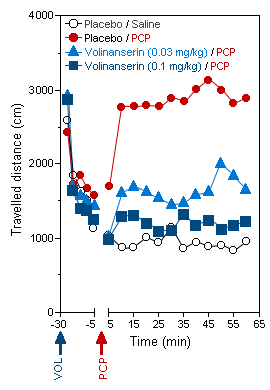
Left panel:
Time-course of locomotor activity of mice in the open field.
Locomotor activity is shown in 5-minute bins following PCP administration. Mice treated with PCP (red symbol) alone displayed a pronounced and sustained increase in locomotion, reflecting hyperactivity. Pretreatment with Volinanserin (0.03 and 0.1 mg/kg, s.c.) dose-dependently attenuated this PCP-induced hyperlocomotion (blue symbols), bringing activity levels close to those of control animals (open symbol). Volinanserin alone did not alter baseline locomotor activity prior to PCP challenge.
-
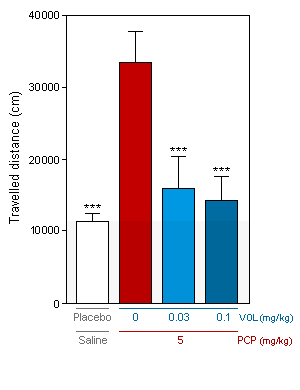
Right panel:
Total travelled distance of mice during the 1 h post-PCP challenge.
Total distance travelled over the 60 minutes following PCP injection is shown. PCP produced a significant increase in locomotor activity (red column) compared with saline controls (open column). Both doses of Volinanserin (blue columns) significantly reduced the PCP-induced hyperlocomotion in a dose-dependent manner, confirming its efficacy in this schizophrenia-relevant model.
-
We look forward to hearing from you.
Get in touch